Solar Photovoltaic System | Electrical Fire Case Studies
As part of renewable energy ecosystem, failures and fires not only involved the solar panel per se, but also the photovoltaic (PV) panels and its balance of system. This article narrates four (4) case studies in relation to the subject matter.
Case Study 1: KEA 10MW Solar Power Plant
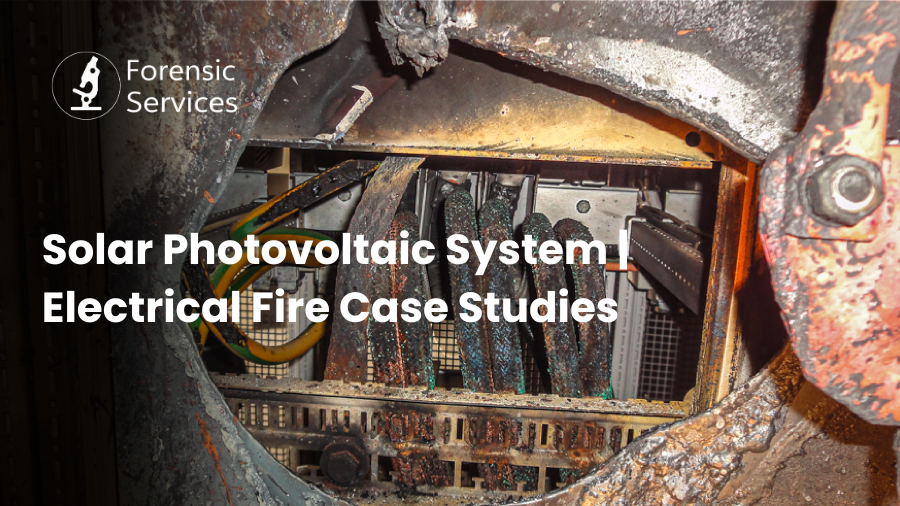
At approximately 08:10 am on 18 March 2018, a fire and smoke event were discovered at “inverter house #1-8”. Workers reported hearing a series of loud explosion-like sound followed by billowing smoke.
Investigators initially considered equipment malfunction or vermin. They also looked into a previous incident where the inverter cabinet was dropped during installation, though this was eventually ruled out because the unit had been rehabilitated and passed commissioning tests.
During the first visit, the investigator was told workers were only under the floor of the inverter house, but it was later revealed that work had been performed inside the room just hours before the fire. There were photographs depicting a worker removing temporary fans from a ladder directly above the open, live inverter panel.
The fire was possibly caused by vibrations from a hammer drill being used beneath the building floor, which caused screws left on top of the cabinet by the worker on the ladder to fall into the live DC incomers and busbar system. Another possibility was that some loose item/s dropped during the worker’s procedures of removing the fans. Because the design lacked insulation barriers and had minimal electrical clearances, a falling screw/item initiated a catastrophic arc-flash event.
Was this incident solely caused by design problem? Lack of upstream circuit breaker protection? Would there be element of negligence by the worker’s procedures? Was the workers’ safety considered when working within a room with live/energised system?
Case Study 2: Kiwi Solar / Albatross Baterai
A fire broke out at a battery manufacturing factory belongs to Albatross Baterai at 8:00 am on 18 December 2018. Kiwi Solar rented the factory’s roof for their industrial solar panels, and the solar panels were extensively burnt.
The initial investigation relied on witness interviews and CCTV footage because the site had not yet been released by authorities.
While the fire ruined the solar panels, the origin was not from the solar system itself.
A forensic fire investigation indicated that the fire originated at an elevated cable tray in the factory’s charging section. The fire spread to the roof structure, which then collapsed, leading to the damage of the solar panels.
Several questions remained. Whether the roof structure is suitable for an erection of third-party solar panels? Was there a proper fire barrier in between? Which parties should be liable if a fire had occurred?
Case Study 3: 50MW Penguin Solar Park
During commissioning in August 2018, the team discovered multiple String Combiner Boxes (SCBs) and communication gateways that had been burned.
The investigators examined 38 SCBs and found varying degrees of fire damage, particularly around the surge protection devices (SPDs) and monitoring modules.
While some failures were overcurrent-related, a specific pattern in 18 boxes suggested damage spreading through the KP138 communication network. A joint investigation revealed an incorrect design and installation of the transient protection circuit.
A lightning strike induced transients in the communication cables. Because the protection system was poorly designed, it failed to suppress the surge, resulting in fires across multiple interlinked boxes.
Had the circuitry been designed and installed in a better manner, will this incident be prevented?
Case Study 4: Kingfisher Fertiliser Godown
On 18 August 2018, black smoke was seen rising from the roof of a fertiliser godown.
Due to COVID-19, a virtual investigation was conducted using aerial drones and video calls.
The solar panels had been installed in 2010 but, as of 2018, they were still not approved for use and had undergone no maintenance for eight years.
The fire originated on the roof in the solar panel area. It was concluded that a fault/failure in a component or cable led to the ignition. This was contributed by years of unmaintained degradation of the roofing materials.
The responsibility of maintaining the solar panel system is in question. Was it owner? Installer? Service team?
Lessons Learnt for Risk Management
- Design Verification: Evidence is required for specialised protection systems, such as lightning/surge protection for communication lines, are installed per manufacturer specifications, as standard “off-the-shelf” components may be improperly integrated.
- Idle Asset Risk: Systems that are installed but not commissioned for years present a high risk due to lack of maintenance and component degradation, which can lead to failure once current is present.
- Third-Party Liability: When panels are on rented roofs, the risk is tied to the host’s operations. The fire safety of the building’s internal processes (e.g., battery charging) is as critical as the solar system itself.
- Strict Housekeeping during Works: Never allow tools, screws, or hardware to be placed on top of live electrical cabinets; even minor vibrations from nearby drilling can cause these objects to fall and trigger an arc-flash.
- Physical Protection Barriers: The facility owners should ensure that live, exposed busbars are fitted with insulating shields and barriers to prevent accidental contact or falling objects from bridging polarities.
- Safety Protocols: Do not permit work to be carried out above open, energised switchboards. Power should be isolated or suitable protective barrier must be used.
- Commissioning Inspections: Ensure that the EPC (Engineering, Procurement, Construction) contractor verifies that “sacrificial” components like SPDs are correctly grounded and matched to the system’s transient levels to avoid premature failure.
Forensic Services provides proficient forensic consultant to investigate fires and failures of PV system and solar farm, especially the large and complex incidents.
Our forensic investigation team applies scientifically grounded root cause analysis methods reinforced by ISO 17025 accredited laboratory to deliver unbiassed and defensive results.
Contact us to discuss how independent fire and failure investigation can assist in claims assessment, litigation backing, and/or process safety management.
Disclaimer
This article is provided solely for general knowledge sharing and educational purposes. It does not constitute legal, engineering, or safety advice. The authors and publisher accept no liability for any loss, damage, or consequences arising from reliance on this article. Readers must refer directly to original authoritative documents, applicable legislation, standards, and qualified professionals when assessing risks or implementing safety measures.
Need clarity on a large and complex incident?
Our forensic consultants are ready to investigate, analyse and support you – from claims to courtrooms.