
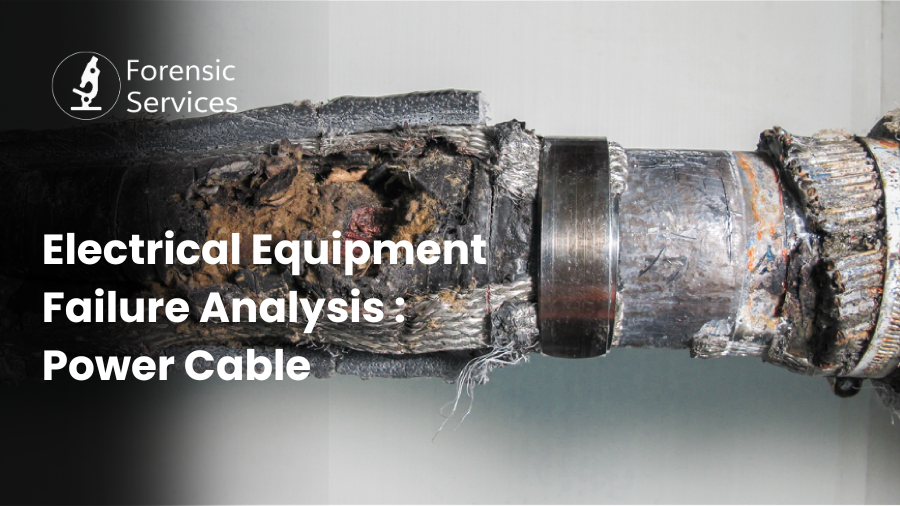
Electrical Equipment Failure Analysis: Power Cable
Failure of power cable and its associated components such as joints, terminations, and insulation are common. We retrieved three (3) case studies in relation to the subject from the database and presented for knowledge sharing purposes.
Case Study 1: Rafflesia Building Complex (11kV Cable Termination)
In January 2008, a power failure occurred in the common areas of the Rafflesia building complex. The site’s electrical chargeman discovered a failed cable end termination within an 11kV circuit breaker. Initial observations noted the building was against a retaining wall with high groundwater seepage, suggesting potential moisture issues.
Forensic investigators inspected the switchgear room and the damaged cable end, which was an older style featuring oil-impregnated paper insulation and a lead sheath. Specifically, the evidence of water ingress or faulty workmanship during the assembly of the termination kit were examined.
Laboratory analysis revealed that the lead sheath had successfully kept the cable dry; no moisture had entered. Workmanship was also found to be correct. There was a technical mismatch: the modern heat-shrink termination kit used was designed for plastic-insulated cables (PVC/Polyethylene), not for the old-style paper-insulated, lead-sheathed cable it was installed on. This created a 3cm gap without proper electrical stress relief, leading to tracking and flashover.
Conclusion:
The failure was attributed to the incorrect application of a termination kit to a cable type for which it was not designed. The investigators recommended that the insured hire a professional engineer to oversee any future high-tension equipment repairs.
Case Study 2: Frangipani LNG Complex (33kV Power Cable Joints)
Two adjacent 33kV cable joints (TR6 and TR8) failed catastrophically within just 24 hours of each other. When the failed joints were cut out, water was seen spraying from the cable under pressure, leading to a suspicion of severe water contamination.
The investigation involved radiographic imaging to locate internal arcing and detailed physical dissections. Investigators looked for the entry point of the water and sand found inside the joints.
- TR6: Water had entered the cable through damage at a distant, unspecified location and travelled down the cable under hydrostatic pressure. What happened here was that the mastic seal meant to protect the joint failed because it did not adhere properly to the lead sheath, likely due to improper preparation/cleaning.
- TR8: This joint had actually been compromised for a long time by an old split in its cover, as evidenced by old sand and organic deposits, yet it had continued to function. It only failed because the failure of TR6 shifted the entire electrical load to TR8, causing it to overheat and finally succumb to the existing damage.
Conclusion:
TR6 failed due to external water pressure and poor seal adhesion. TR8’s failure was a cascading event caused by additional stress placed on an already compromised joint following the TR6 incident.
Case Study 3: Ixora Hibiscus Resort (415V Cable Failure)
Following heavy rain in January 2008, a 415V power line serving resort chalets repeatedly tripped. Given the resort’s hilly location and the stormy weather, lightning was the primary suspicion.
The investigator interviewed the chargeman and examined available cable sections. Testing by a contractor showed the cable had shorted at multiple locations upstream.
Lightning was ruled out because sensitive electronic equipment and telephone lines in the same area were undamaged. There was a specific cable joint that was originally buried but had surfaced due to soil erosion which caused this failure. Long-term exposure to UV radiation from the sun made the joint’s casing brittle and porous.
Conclusion:
The failure originated at the deteriorated, sunlight-exposed joint. Rainwater seeped into the brittle casing, causing a short circuit that then triggered collateral damage (overcurrent) further up the main cable line.
Lessons Learnt for Risk Management
For the Insurer:
- Verify Equipment Compatibility: As seen in the Rafflesia Building Complex case, a loss can occur even with “correct” workmanship if the components are fundamentally incompatible. Insurers should verify that repair materials are “fit for purpose” for older infrastructure.
- Understand Cascading Risks: The Frangipani LNG case highlights that the failure of one component can trigger the failure of a “stable” but compromised neighbour due to increased load. Risk assessments should consider the redundancy and health of the entire system, not just individual parts.
- Monitor Environmental Changes: Claims attributed to lightning strike may actually be due to preventable maintenance issues like soil erosion exposing underground assets.
For the Policy Owner:
- Supervise Technical Repairs: Policy owners should not assume contractors will always use the correct parts. Engaging a Professional Engineer (PE) to oversee high-voltage repairs can prevent costly mismatches.
- Proactive Infrastructure Maintenance: Regularly inspecting the physical environment (e.g., checking for soil erosion or exposed cables) can prevent the gradual deterioration of joints not meant for surface exposure.
- Quality Control in Workmanship: Small details, like the proper cleaning of a lead sheath before applying mastic tape, are critical. Verbal training for jointers is not a substitute for rigorous adherence to manufacturer specifications and documented procedures.
Forensic Services Malaysia provides proficient forensic consultant to investigate failures of power cable system, especially the large and complex incidents.
Our forensic investigation team applies scientifically grounded root cause analysis methods reinforced by ISO 17025 accredited laboratory to deliver unbiassed and defensive results.
Contact us to discuss how independent failure investigation can assist in claims assessment, litigation backing, and/or risk management.
Disclaimer
This article is provided solely for general knowledge sharing and educational purposes. It does not constitute legal, engineering, or safety advice. The authors and publisher accept no liability for any loss, damage, or consequences arising from reliance on this article. Readers must refer directly to original authoritative documents, applicable legislation, standards, and qualified professionals when assessing risks or implementing safety measures.
Need clarity on a large and complex incident?
Our forensic consultants are ready to investigate, analyse and support you – from claims to courtrooms.