
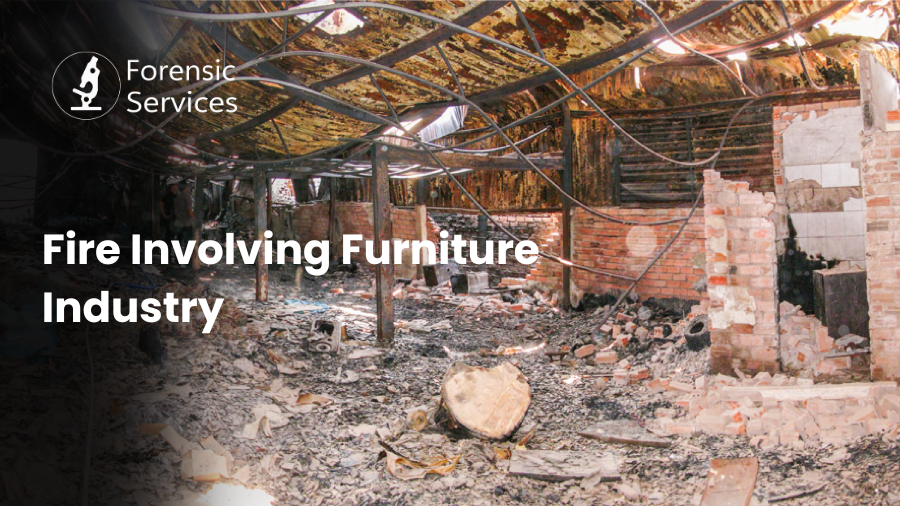
Fires Involving Furniture Industry
Among some ten (10) past fire incidents involving furniture manufacturing, storing and trading buildings, electrical ignition source remains the top leading cause of fire. At the manufacturing sector, spontaneous ignition and frictional sanding spark were determined as the fire causes. Other possibilities such as smoking materials and deliberate human involvement were also evaluated systematically.
Highlights of the Respective Causes of Furniture Fires
- Spontaneous ignition. The fire originated in a spray booth and was most probably caused by self-heating and spontaneous combustion of caked, dry Nitrocellulose (NC) lacquer overspray deposits.
- Electrical charger malfunction. The fire most likely initiated due to an electrical failure in a forklift charging cable left plugged in overnight.
- Frictional sanding spark. Fine wood dust was ignited by frictional heat or sparks generated during the sanding process, which was then vacuumed into the dust collection system, initiating a fire inside the collector bag.
- Electrical fault near wood dust. The fire was likely caused by a fault in overhead electrical supply cables initiating a slow smoulder in wood dust deposits that had accumulated on top of the ceiling.
The Fuel Load Dynamics that Should Not be Ignored
Highly Flammable Fuel Types
- The Hazard: Materials common in furniture manufacturing, specifically polyurethane (PU) foam, polyester fibre, fabrics, and plastics, are highly combustible and burn with an exceptionally high rate of heat release.
- The Risk: When ignition occurs near these materials, fire spread is nearly instantaneous. Standard packaging materials stored in bulk on-site, such as polystyrene foams, plastic wrapping films, and flattened corrugated cardboard cartons, are highly effective in quickly overwhelm early-stage fire-fighting efforts.
Configuration of Combustibles
- The Hazard: To maximize space, factories often stack materials vertically on high decks or multi-tier storage racks (e.g., stacking finished sofas on high racks, piling furniture 6 to 8 feet high, or stacking banquet chairs 10-unit high).
- The Risk: Not only the volume of fuel load will augment the fire spread, the effectiveness of early detection system and fire suppression system may not be able to stop the fire at its inception stage.
Fire Risk Management Strategies
The reports also offer case studies in how inventory management dictates fire severity:
- Just-In-Time (JIT) Success: Magnificent Furnitures Pte Ltd utilised a “Just-In-Time” inventory system, keeping sawn timber stock restricted to only 2 to 3 days of production demand. Investigators explicitly noted that this housekeeping standard and limited distribution of combustible materials over the floor space successfully prevented the fire from spreading to the entire factory.
- Mass Stockpile Failures: In contrast, factories that allowed finished goods, raw foam, and highly combustible packaging to accumulate adjacent to active production lines or charging stations suffered devastating, uncontrolled spread that resulted in total structural collapses.
Lessons Learnt for Risk Management
For the Insurance Practitioners
- Sprinkler System Vulnerabilities: Underwriters should note how easily standard protection systems are compromised. At a sofa manufacturing site, the rapid combustion of polyurethane-padded sofa backs immediately triggered a massive, system-wide sprinkler activation that overwhelmed the local water supply pressure. Furthermore, high-tier storage racks can physically hinder sprinkler spray from reaching fires on lower levels.
- Open Floor Plans & Rapid Downward Spread: Multi-storey facilities with open stairwells, wooden floorboards, and non-fire-rated dividing walls allow rapid vertical and horizontal spread. In Valyria Furniture’s case, the use of epoxy-coated steel plates for flooring acted as highly efficient heat conductors, causing the burning coating to peel, drop down, and ignite lower levels instantly.
For the Asset Manager
- The Silent Hazard of NC Lacquer: Finishing departments must realise that dry Nitrocellulose (NC) lacquer is inherently unstable. If overspray is allowed to build up into thick, caked layers inside spray booths, the nitrocellulose decomposes exothermically. Because thick layers trap the heat rather than dissipating it, it can easily lead to self-heating and spontaneous ignition. Rigorous daily cleaning of spray booths is non-negotiable.
- Sanding & Dust Collector Integration Risks: Supreme Furniture Company incident highlights that a spark does not have to occur inside a dust collector to destroy it. Plant managers must monitor the wear and alignment of sanding belts, as frictional sparks can travel directly through suction ducts and smoulder inside dust bags unnoticed.
- Housekeeping on False Ceilings: Dust management cannot stop at the floor level. The Magnificent Furnitures fire proves that wood dust settling on top of false ceilings can be ignited by a minor electrical cable fault, smouldering out of sight for hours before erupting into a major fire.
- Forklift Charging Management: Industrial battery charging stations are high-risk zones. Charging cables are handled daily and easily suffer physical damage, leading to short-circuits. Charging areas must be kept entirely free of nearby combustibles like polystyrene foam or flattened cartons.
Consulting Scientist/Chemist of Forensic Services Malaysia investigated numerous major, complex, and large fires involving furniture assembly, warehousing, and showrooms.
Grounded in scientific method, our forensic investigation and root cause analysis are holistically carried out. The in-depth analysis is reinforced by ISO 17025 accredited laboratory. Analysis of fire debris samples are conducted in-house, dedicatedly.
Contact us to discuss how an independent forensic fire investigation can assist in claims management, litigation support, and/or risk assessment.
Disclaimer
This article is provided solely for general knowledge sharing and educational purposes. It does not constitute legal, engineering, or safety advice. The authors and publisher accept no liability for any loss, damage, or consequences arising from reliance on this article. Readers must refer directly to original authoritative documents, applicable legislation, standards, and qualified professionals when assessing risks or implementing safety measures.
Need clarity on a large and complex incident?
Our forensic consultants are ready to investigate, analyse and support you – from claims to courtrooms.