
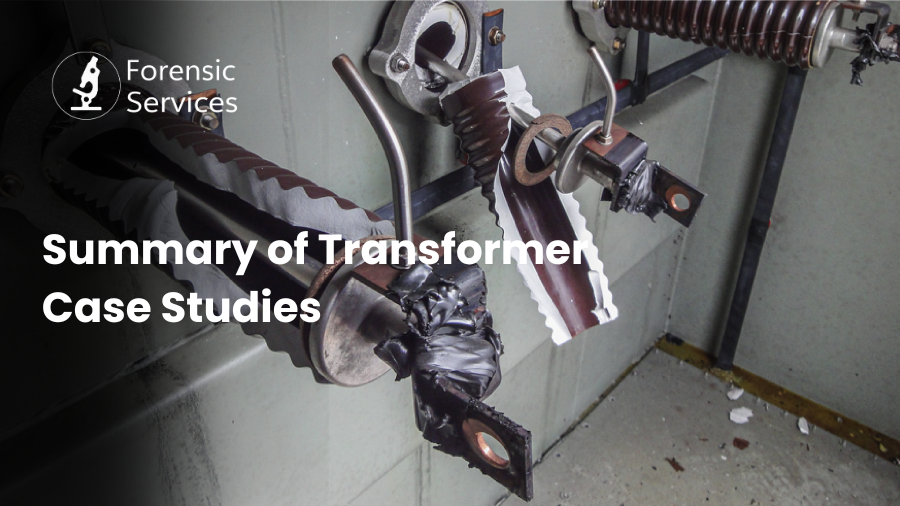
Summary of Transformer Case Studies
Forensic Services Malaysia has conducted hundreds of transformer related cases in the past four (4) decades. Among them, twelve (12) were extracted and summarised for knowledge sharing purposes.
Case 1: Daya Electronics
A 2,000kVA transformer suffered a catastrophic internal failure only two seconds after being re-energized under load. FSM investigators reviewed historical maintenance reports, which revealed significant gaps in testing. They also examined the failed assembly, noting severe compression of coil stacks and arcing damage. While the oil was heavily sludged and contained moisture, the immediate cause was not the oil itself. Instead, the repair process for a previous tap changer failure had likely placed excessive tension on aged, flexible conductors, causing them to part when the load was applied.
Final Resolution: The failure was attributed to the repair method stressing the internal assembly rather than the original fault.
Case 2: Arus Foundry
A furnace transformer failed with a loud explosion sound, and the tank walls were found to be bulged. Electrical insulation tests showed zero resistance between all coils and earth. Forensic examination of the LT bushings revealed shattered porcelain and fused copper spatter. The investigation determined that prolonged arcing at a central connection tag had eroded a clamping nut, eventually causing a full flashover across all three phases.
Final Resolution: The electrical surge destroyed the coils, and the resulting flashover vaporized the oil, creating the explosive force that deformed the tank.
Case 3: Kuryente Corp
A security guard witnessed fire and sparks in a transformer bay, followed by explosions. Forensic engineers discovered that the cable support system had collapsed. They also noted that historical thermographic scans had repeatedly flagged severe heating at cable terminations. It was found that the crimp lugs were undersized for the required current, and the use of thin washers prevented proper contact pressure. This caused the copper conductors to “migrate” through the softened PVC insulation over time.
Final Resolution: A short circuit occurred when a conductor touched earthed metal, rupturing the explosion vent and igniting the disgorged oil.
Case 4: Grid Gardu Induk
A new 90MVA transformer arrived at the site but failed a pre-commissioning check due to extremely low insulation resistance between the core and the tank. The unit was gouged open at a workshop for internal inspection. Investigators looked for impact damage from transport but found none. A thorough investigation by FSM electrical engineer revealed that significant rust staining was found inside the tank, along with a water mark at the bottom. This was traced to water ingress through a tertiary bushing blanking plate that had a compromised gasket during 18 months of outdoor storage.
Final Resolution: The failure resulted from a lack of nitrogen pressure monitoring and poor sealing of temporary transport plates.
Case 5: Werpa Inc.
The plant suffered a sudden partial power loss accompanied by explosions and smoke from the transformer room. The transformer tested at zero resistance to earth. FSM investigators examined the cable trenches and found severely charred non-armoured cables. The cables had been bundled tightly in four layers within a sand-filled trench, contrary to good practice. This led to severe de-rating and heat buildup.
Final Resolution: A phase-to-phase fault in the cables imposed a close-up shorting fault that internally damaged the transformer’s coil sets.
Case 6: Dien Corporation
A lightning storm caused a total blackout and fire-crackling noises in the substation. The HT switchgear and protection relays were found to be badly damaged by voltage transients. The transformer was removed for internal inspection at the factory. Upon opening, the transformer assembly was found to be in excellent physical and electrical condition.
Final Resolution: The transformer had not failed; the loss of power was due to damage to the upstream HT network and protection equipment.
Case 7: Trafo Campus
Three identical 2000kVA dry-type transformers failed sequentially over a nine-month period. Inspections revealed substantial ruptures and heavy sooting within the HT coil stacks. Upon a detailed examination by the attending forensic consulting engineer, there was no evidence of overheating or external transients. Instead, the cyclical loading of the campus (high daytime use, low night use) caused differential thermal expansion between the copper and resin.
Final Resolution: This movement created voids that initiated partial discharges, leading to inter-turn failures.
Case 8: Port Arde
A new 300MVA transformer was dropped when a hydraulic hose burst during maneuvering. Pressure tests initially suggested the On-Load Tap Changer (OLTC) chamber might be leaking into the main tank. After FSM was engaged, a more rigorous test using oil and dry air showed no air bubbles, proving the OLTC tank was intact. The previous results were likely due to air bubbles trapped in the oil during filling or valve issues.
Final Resolution: The transformer tank and internal assembly were unaffected; however, debris left from the manufacturing process was discovered and required cleaning.
Case 9: Plaza Kabel
Significant oil leakage was discovered on the transformer room floor. Following an investigation, the leak was traced to the yellow phase HT terminal of one transformer. It was found that workers had recently replaced HT cables. Dismantling the terminal revealed that the gasket had been torn.
Final Resolution: The leak was caused by excessive force applied by sub-contractors during the installation of the HT cables.
Case 10: Day Dong Inc.
A 100MVA transformer failed following an explosion during a lightning storm. Visual inspection showed the 13.8kV tertiary bushings were shattered, and the surrounding enclosure was bulged. Unlike the 138kV and 69kV lines, the 13.8kV tertiary circuit had no transient protection.
Final Resolution: A lightning strike induced a voltage transient in the tertiary cables, causing a flashover that shattered the bushings, released oil, and ignited a fire.
Case 11: Voltan Chemical Industries
A rectifier transformer tripped suddenly, and multiple thyristors and fuses were found damaged. Historical oil tests since 2004 showed a trend of high moisture, acidity, and furanic compounds. Internal inspection revealed brittle and charred insulation. Following FSM’s consulting engineer’s site visit, it was revealed that the plant had modified the cooling system in 2008 to reduce temperatures, but the damage had already started years earlier.
Final Resolution: The failure was caused by long-term overheating and the resulting insulation breakdown.
Case 12: Elektrisidad Grid
A 292MVA step-up transformer tripped with an explosion; oil was seen leaking from all HV bushings. Copper winding samples showed a heavy black deposit. Oil analysis was performed for corrosive sulphur. Resulting from Forensic Services Malaysia’s detailed investigation, laboratory tests detected 13ppm of Dibenzyl Disulphide (DBDS) in the oil.
Final Resolution: DBDS produced copper disulphide deposits on the paper insulation, compromising its dielectric strength and leading to an arc-flash failure.
Lessons Learnt for Risk Management
For Facility Owner
- Comprehensive Monitoring: Regular oil tests, including Dissolved Gas Analysis (DGA) and Furan tests, are critical for detecting early-stage insulation degradation. New threats like DBDS require specialized testing to prevent catastrophic failures in units that otherwise appear healthy.
- Installation Quality Control: Many failures resulted from poor workmanship, such as using undersized cable lugs, applying excessive force to terminals, or improperly bundling cables in trenches. Strict supervision of sub-contractors is essential.
- Environmental Protection: Transformers stored outdoors must have their nitrogen pressure monitored regularly to prevent moisture ingress. Similarly, tertiary windings and underground cables should not be overlooked for lightning protection.
- Operational Awareness: Equipment subject to cyclical loading may face unique risks like internal voids and partial discharges, even if they are not overloaded.
For Insurers/Loss Adjusters/Risk Surveyors
- Maintenance Record Verification: The presence (or absence) of consistent maintenance records is a strong indicator of risk. Gaps in testing often precede catastrophic failures.
- The “Treating Symptoms” Trap: Facility owners may attempt to fix oil quality (filtering/purifying) without addressing the underlying insulation damage, which can lead to a false sense of security.
- Forensic Requirement: Initial suspicions (e.g., lightning) are possibly wrong; only detailed internal inspections can distinguish between external transients, manufacturing defects, and poor repair practices.
- Root Cause Depth: Insurers should be aware that the manner of repair for a minor fault can sometimes cause a more severe second failure, as seen in the Daya Electronics case.
Forensic Services Malaysia provides skillful forensic electrical engineers to investigate failure incidents of transformers.
Grounded in scientific method, our forensic investigation conducted root cause analysis in the investigation. The in-depth analysis is reinforced by ISO 17025 accredited laboratory to deliver unbiassed and defensive results.
Contact us to discuss how an impartial failure investigation can assist in claims assessment, litigation backing, and/or risk management.
Disclaimer
This article is provided solely for general knowledge sharing and educational purposes. It does not constitute legal, engineering, or safety advice. The authors and publisher accept no liability for any loss, damage, or consequences arising from reliance on this article. Readers must refer directly to original authoritative documents, applicable legislation, standards, and qualified professionals when assessing risks or implementing safety measures.
Need clarity on a large and complex incident?
Our forensic consultants are ready to investigate, analyse and support you – from claims to courtrooms.