

Advanced reconstruction integrates measured data, engineering analysis, and validated simulation.
Introduction
Motor vehicle accidents rarely speak for themselves.
By the time investigators arrive, vehicles may have been moved, debris cleared, and witness recollections influenced by stress or perception. What remains is fragmented physical evidence that must be translated into a scientifically defensible explanation of how and why the collision occurred.
Forensic vehicle accident reconstruction plays a critical role in bridging this gap. It applies engineering science, investigative methodology, and analytical reasoning to objectively determine collision dynamics, contributing to legal clarity, insurance evaluation, and improved road safety outcomes.
Today, reconstruction is no longer limited to manual calculations and scale sketches. Physics-based modelling platforms such as Virtual CRASH 6 now allow investigators to test hypotheses, evaluate consistency with physical evidence, and present findings in a scientifically transparent manner.
The Foundation: Evidence Before Interpretation
Consistent with established forensic practice, reconstruction begins with evidence collection rather than computer modelling. The investigative process follows a structured methodology grounded in documentation, preservation, and analysis.
Key datasets include:
- Scene measurements obtained through surveying or photogrammetry
- Vehicle crush profiles and deformation mapping
- Tyre marks, gouges, and roadway geometry
- Event Data Recorder downloads where available
- Video recordings, environmental conditions, and witness timelines
Digital tools allow these datasets to be incorporated into a scaled three-dimensional environment. This ensures that any simulation is anchored to measured reality and not visual speculation.
Scientific Principles That Govern Reconstruction
Accident reconstruction is fundamentally an application of classical mechanics and engineering analysis. Core principles include:
- Conservation of momentum to evaluate impact severity and direction
- Energy dissipation through structural deformation
- Tyre road friction relationships affecting braking and sliding motion
- Vehicle kinematics describing translation and rotation during impact
These principles form the analytical backbone described in foundational reconstruction literature and remain unchanged despite advances in technology. Software simply provides a more efficient platform for applying them.
From Documentation to Analytical Modelling
Traditional reconstruction relied heavily on hand calculations, vector diagrams, and iterative estimation. While still valid, this approach limited the ability to examine multiple competing scenarios efficiently.
Modern simulation environments extend the analytical process by enabling:
Rapid Scenario Testing
Investigators can vary speed, impact angle, and driver inputs to determine which combinations are physically consistent with the evidence.
Momentum-Based Collision Analysis
Time forward simulation allows reconstructionists to model vehicle interaction using impulse momentum relationships, linking pre-impact motion to final rest positions.
Integration of Measured Data
Time series inputs such as acceleration, steering behaviour, or EDR-derived speed profiles can be incorporated directly into the analytical model, reducing assumptions and improving reliability.
Reconstructing the Scene in Three Dimensions
A significant advancement in the discipline is the ability to recreate the physical environment with high fidelity.
Modern reconstruction workflows can:
- Import laser scan or photogrammetric point clouds
- Apply aerial imagery scaled to surveyed control points
- Model roadway grades, crossfalls, and elevation changes
These environmental details are essential because vertical geometry can materially influence braking performance, vehicle stability, and post-impact travel distance.
Expanding Analysis Beyond Vehicle-to-Vehicle Collisions
Contemporary investigations increasingly involve complex interactions such as:
- Pedestrian and cyclist impacts
- Motorcycle dynamics and rider kinematics
- Multi-vehicle and articulated transport collisions
Multibody dynamics modelling allows these scenarios to be evaluated within the same scientific framework, integrating traffic engineering, human factors, and mechanical analysis into a unified reconstruction.
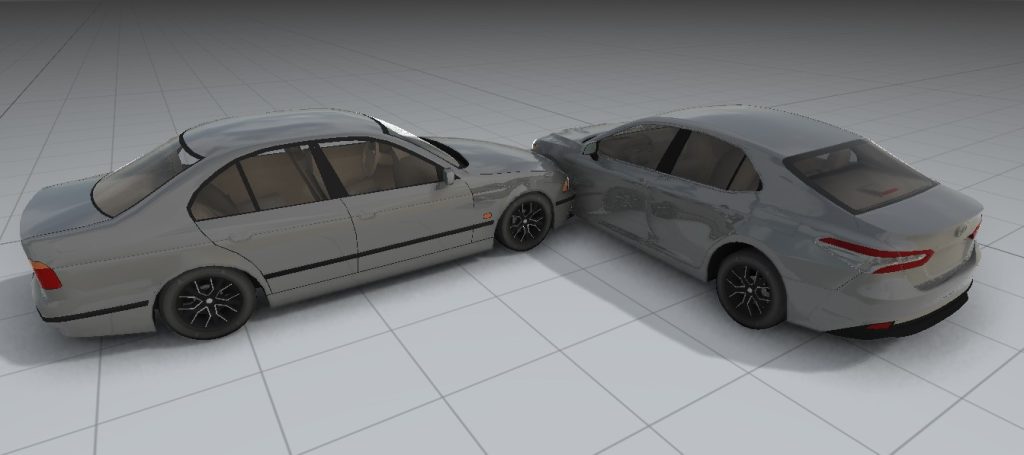
Visualisation as an Analytical Tool
Visualisation is often misunderstood as merely demonstrative. In practice, it is an analytical extension of the reconstruction process.
It enables investigators to:
- Evaluate line of sight and perception response opportunities
- Assess whether claimed manoeuvres are physically achievable
- Examine environmental influences such as lighting or obstruction
When grounded in validated inputs, visual outputs are explanatory tools derived from engineering analysis rather than advocacy graphics.
Engineering Transparency and Forensic Reliability
For reconstruction findings to be admissible and credible, the methodology must remain transparent and reproducible.
Modern analytical platforms support this requirement by allowing investigators to:
- Define vehicle mass, stiffness, and geometry parameters explicitly
- Conduct sensitivity analyses to understand uncertainty
- Maintain traceability between assumptions, calculations, and outcomes
This aligns with the long-standing forensic principle that conclusions must be based on demonstrable scientific reasoning rather than interpretation alone.
The Evolving Role of Technology in Reconstruction
While the discipline continues to adopt digital tools, its objective remains unchanged. Reconstruction seeks to determine what happened, how it happened, and whether physical evidence supports the accounts presented.
Emerging developments include:
- Integration of telematics and connected vehicle data
- Automated evaluation of multiple hypotheses
- Faster analytical turnaround for insurers and legal practitioners
- Increasing use of digital scene preservation techniques
Despite these advances, the most critical element remains the expertise of the investigator. Technology accelerates analysis, but professional judgment ensures scientific validity.
Conclusion
Vehicle accident reconstruction has evolved from tape measure geometry and manual computation into a multidisciplinary forensic science supported by advanced analytical tools.
By combining physical evidence, engineering mechanics, and validated simulation environments, modern investigators can reconstruct collisions with improved accuracy and clarity. This scientific approach supports courts, insurers, and stakeholders in making decisions grounded in evidence rather than assumption, reinforcing the essential role of forensic investigation in understanding vehicle accidents.
Appoint a competent specialist
Need clarity in a complex collision?
Our forensic engineering team applies scientifically grounded reconstruction methods supported by advanced physics-grounded simulation tools to deliver objective, defensible findings.
Contact us to discuss how independent vehicle accident reconstruction can assist in claims evaluation, litigation support, or technical advisory services.
References
- Virtual CRASH 6 Product Information and Technical Features
- Science and the Law Primer for Collision Reconstruction, Northwestern University Centre for Public Safety
- Vehicular Accident Investigation and Reconstruction, Donald J. Van Kirk, CRC Press, 2000
Disclaimer
This article is provided solely for general knowledge sharing and educational purposes. It does not constitute legal, engineering, or safety advice. The authors and publisher accept no liability for any loss, damage, or consequences arising from reliance on this article. Readers must refer directly to original authoritative documents, applicable legislation, standards, and qualified professionals when assessing risks or implementing safety measures.
Need clarity on a large and complex incident?
Our forensic consultants are ready to investigate, analyse and support you – from claims to courtrooms.